
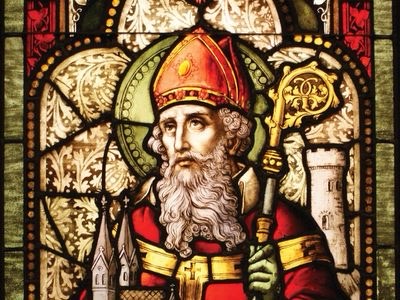
Everyone knows of St. Patty’s Day, but do you really know much of St. Patrick himself? His feast, March 17th, is widely celebrated, but it is easy to lose sight of why we commemorate him with this festive day.
St. Patrick’s Day is filled with all things Irish and green because St. Patrick evangelized Ireland, converting numerous to Christianity. He was a zealous Catholic missionary, fortified in his faith, and he also wrote a work titled Confessio in which he humbly details his spiritual journey. St. Patrick is now the beloved patron Saint of Ireland.
St. Patrick was alive during the late fourth century into approximately the mid fifth century. As a child in Roman Britain, he was not invested in the Catholic faith or in knowing God. His life drastically changed, however, when he was kidnapped by Irish pirates and made a slave in Ireland. For six years, he was forced to be a shepherd, but during this time of enslavement, he found God and grew in relationship with him.
“It was there that the Lord opened up my awareness of my lack of faith. … I turned with all my heart to the Lord my God, and He looked down on my lowliness,” St. Patrick wrote in his Confessio.
After receiving a vision from God and escaping his captivity, St. Patrick went back to Britain. Later, he went on to become a priest and bishop, and he received in a dream a vision which prompted him to return to Ireland. He spread Catholicism and established churches throughout the country.
“In the knowledge of this faith in the Trinity, and without letting the dangers prevent it, it is right to make known the gift of God and His eternal consolation. It is right to spread abroad the name of God faithfully and without fear, so that even after my death I may leave something of value to the many thousands of my brothers and sisters – the children whom I baptised in the Lord,” St. Patrick wrote in his Confessio.
Having lived so long ago, there is some obscurity surrounding his story. It is said that St. Patrick forced all snakes to leave Ireland. However, it has not been proved that snakes ever did inhabit Ireland, so this story may be intended to symbolize St. Patrick’s work of expelling paganism from the country.
It is also a commonly held belief that St. Patrick taught about the Trinity with a shamrock or clover, but this is uncertain and would be a little odd because the metaphor falls short. The three-leaf clover analogy for the Trinity can succumb to the heresy of partialism, which says that each member of the Trinity makes up part of God but is not wholly God Himself but rather a third of God.
On St. Patrick’s Day, we remember a man who faithfully and boldly served the Lord, and we ask for his intercession, that we may also proclaim Christ with our lives and recognize His presence with us and in the world.